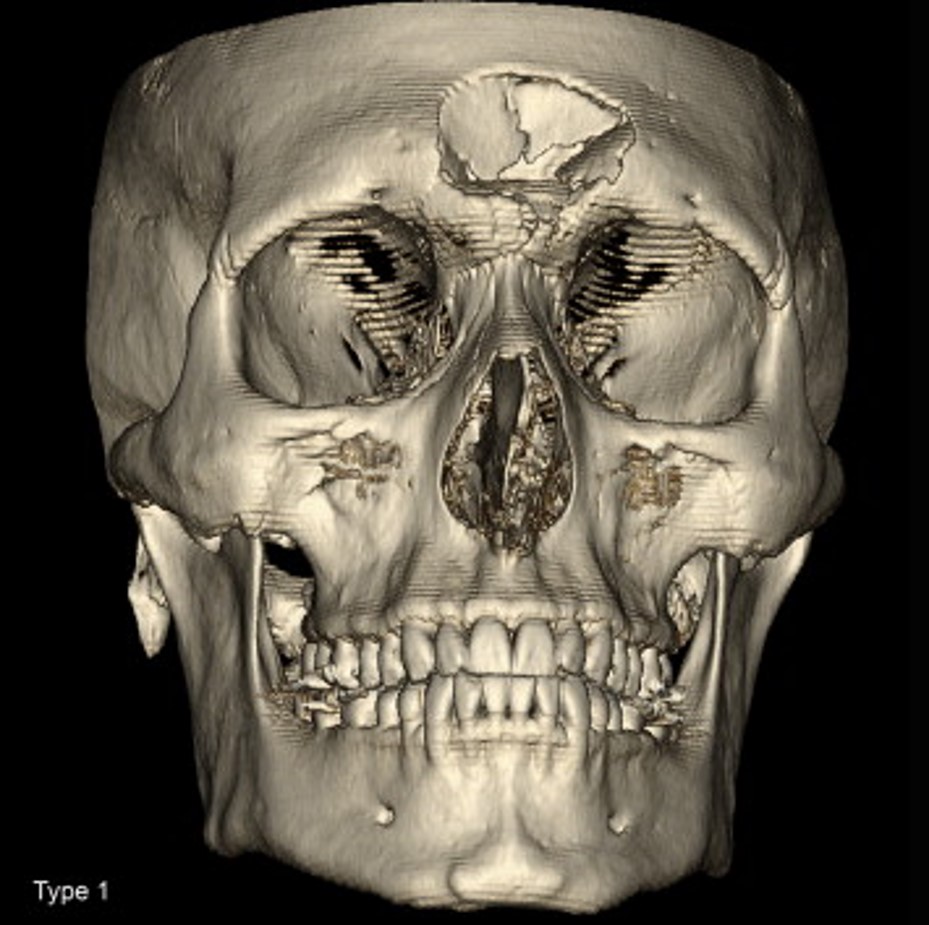
Case

A 16 year old patient is admitted after having been struck in the face just superior to the eyes during hockey practice. The patient is awake and talking but complaining of severe head pain near his forehead associated with soft tissue bruising. The patient also has blood coming from their right nose.


Question 3/3 - What nerves may have been injured?

Click on your selected option(s) below  (correct = 1, possible = 2, over-thinking = 3+)

Incorrect. The mental nerve (terminal part of the trigeminal V3 nerve) emerges from the mental foramen near the chin, distant from this injury. This nerve can be assessed by testing sensation from the skin round the chin (mentum).

Incorrect. The infraorbital nerve (terminal part of the trigeminal V2 nerve) emerges from the infraorbital foramen below the eye, distant from this injury. This never can be assessed by testing sensation from the mid-face.

Correct! The supraorbital nerve (and supratrochlear nerve, one that we will not cover in detail) are terminal branches of the trigeminal V1 nerve, these emerge from the supraorbital foramen and spread over the forehead. While the supraorbital foramen does not appear to be directly injured, branches of V1 cover the area of the injury and would be at risk.

Nerve injury could be from transection or temporarily impeded by inflammatory responses. This nerve can be tested by assessing sensation from the forehead.

Incorrect. The optic nerve is posterior to the eye traveling through the optic canal, some distance from the injury and less likely at risk. 

Possible. The facial nerve emerges from the stylomastoid foramen near the mastoid process, distant from the injury.  Branches do, however, extend to the frontalis muscle which is in the injured region. So, while the main nerve itself is unlikely to be injured these frontal distal branches to the muscle could be.