Case

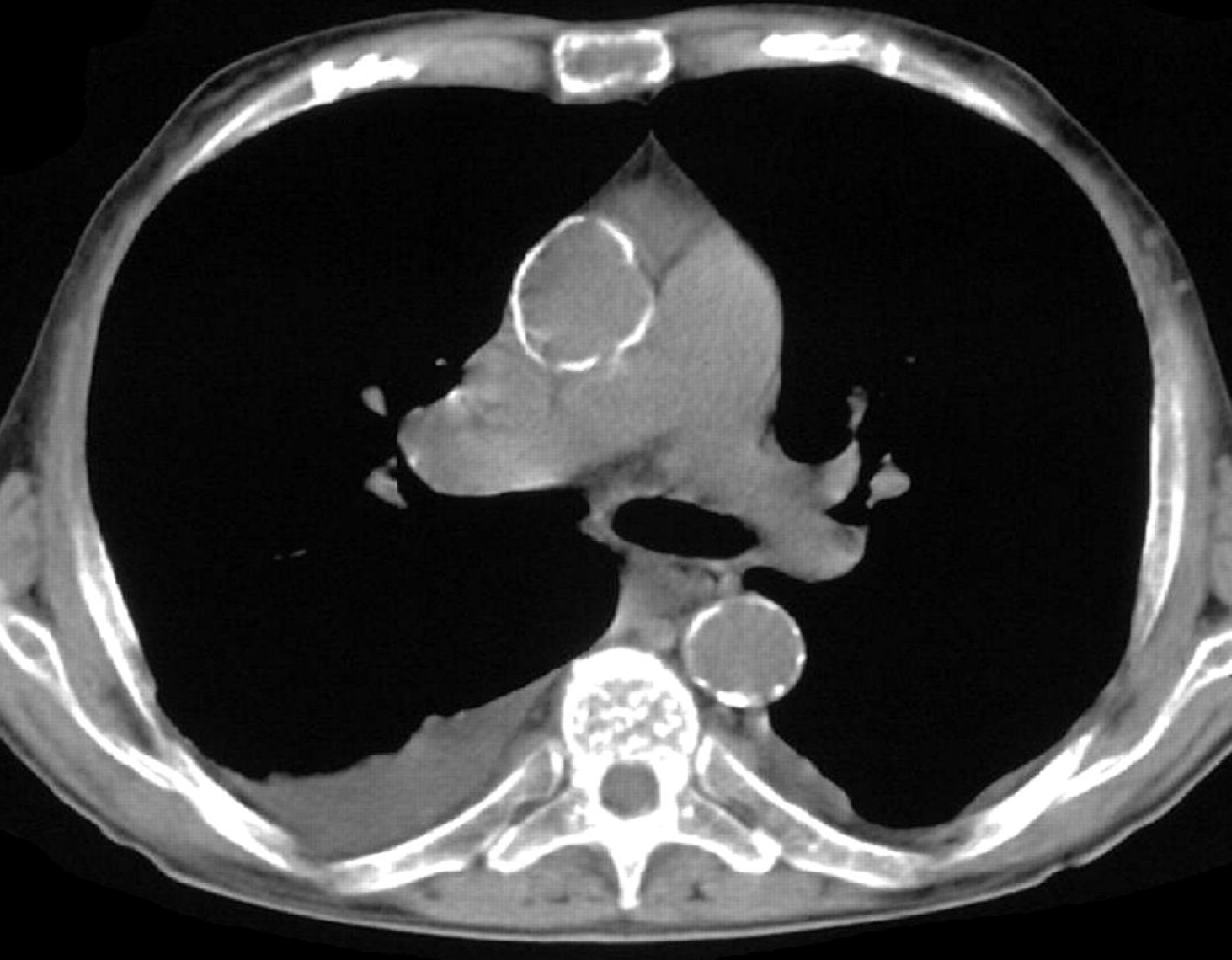
An 83 year old patient comes to the pulmonology division complaining of shortness of breath with any physical activity, persistent fatigue, and periods through the day where they reports having rapid and somewhat irregular heartbeat. Physical examination is otherwise unremarkable. A CT scan is ordered.


Question 2/3 - What is causing the signal enhancement (brightness) surrounding the ascending and descending aorta?

Click on your selected option(s) below  (correct = 1, over-thinking = 2+)

Incorrect. Air is dark in a CT scan, not bright.

Incorrect. Ischemic tissue would have density the same as other soft tissues, an intermediate grey.

Correct! Remember 'bone is bright' and those aortic signal enhancements have similar intensity to the ribs/vertebra, thus are 'bone-like' calcifications.

Incorrect. Blood clots are soft tissue and would have similar density to the blood inside the aorta or to other soft tissues, an intermediate grey.

Incorrect. A good thought to consider artificial hardware which is often metals, but in this case it seems unlikely to have a discontinuous hardware spanning both regions of the aorta. 

Incorrect.  While arterial contrast would have the same intensity as bone (i.e. bright) the contrast would fully fill the arteries and not just the walls. Since the center and all other arteries are an intermediate grey of soft tissue, we can conclude there is no contrast present.