Case

A 54yo male patient presents with lower back pain that radiates down the back of their right leg. The patient states that the pain increases when they lean forwards (flex) particularly if lifting a weight, but decreases when they lean backwards (extend). The patient experiences pain, but has a normal range of motion of the spine.

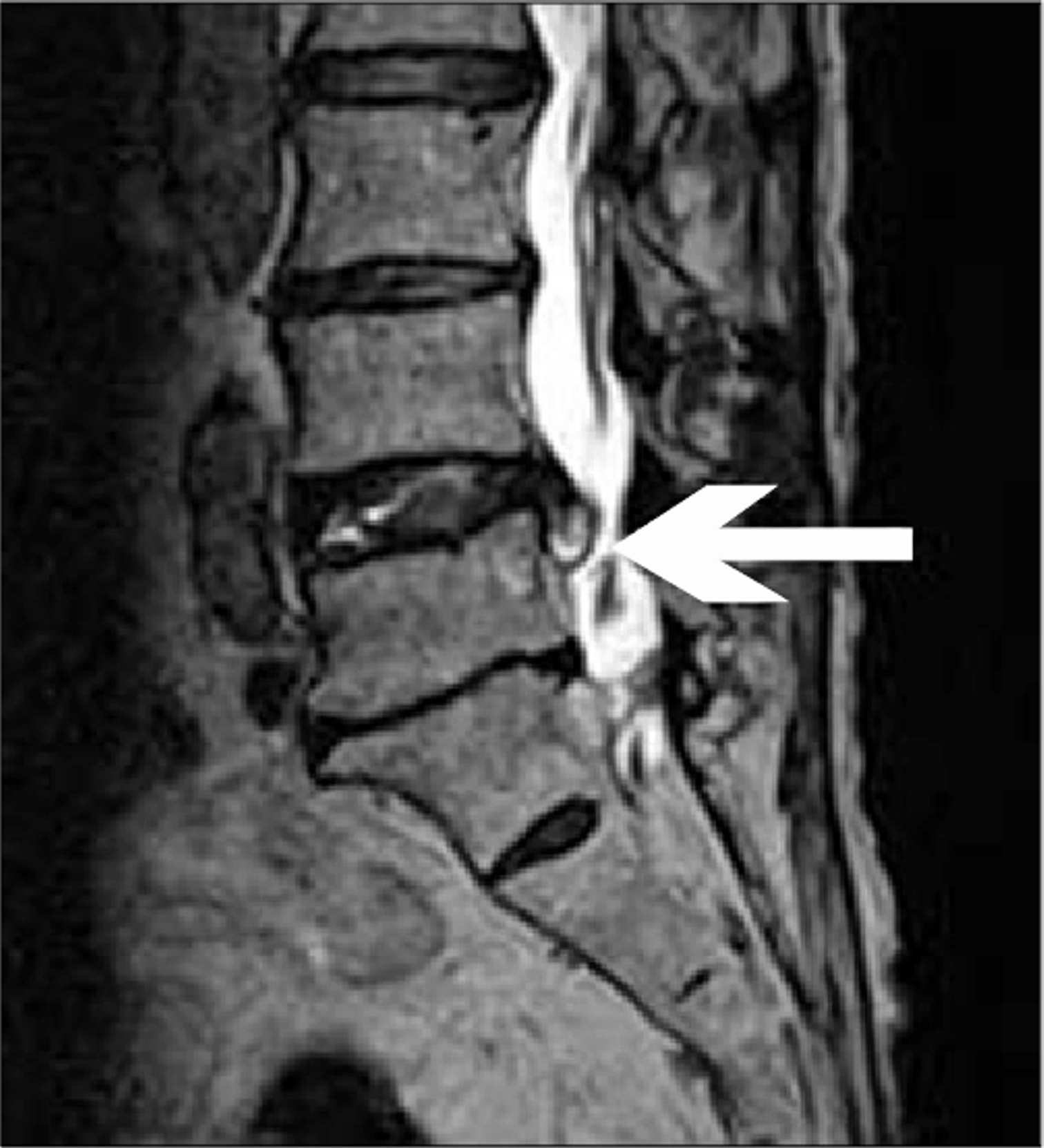
Question 2/2 - The patient undergoes an MRI as below identifying a paracentral herniated intervertebral disk.

Based on the patient history and radiology findings, which spinal nerve is most likely affected?

Click on your selected option(s) below  (correct = 1, over-thinking = 2+)

Incorrect. There are small bulges more superior to the affected L4 disk (bulges at L2 and L3 disks), but these are not the primary problem identified by the arrow

Incorrect. While the L4 intervertebral disk is the one bulging, the nerve root affected is most commonly not the L4 root.    

Correct!  Paracentral herniated disks in the lumbar area affect the spinal nerve below the bulging disk. In this case the L4 disk is herniated which would impinge on the L5 nerve root.

Incorrect. The disk where the S1 nerve root could be affected appears normal in this patient. The L5 disk would impact the S1 nerve root, and the L5 disk appears normal (the L4 disk is impacting in the image). 

Incorrect. The vertebra of S1 and S2 fuse during development such that there is only residual disk material present.  Due to the conversion primarily to bone during the fusion of the sacral vertebra, there is unlikely to be a herniation of residual S1 disk tissue.